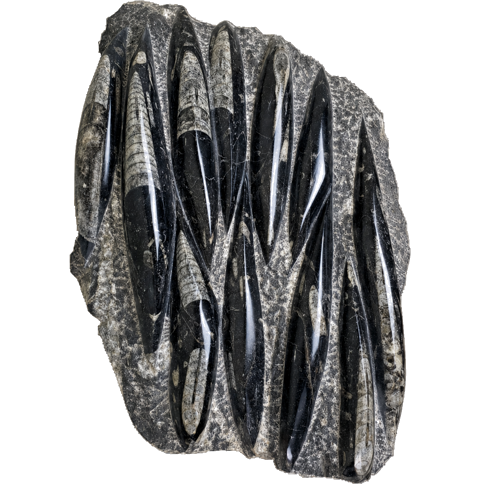
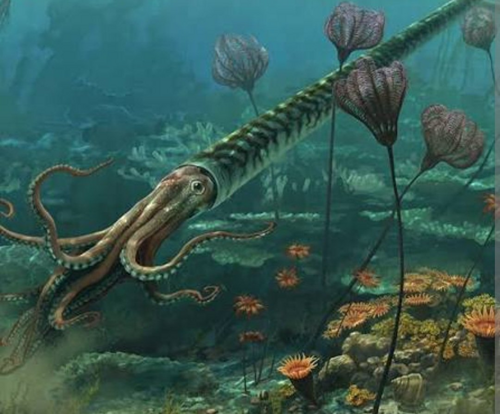
About the item: An impressive and highly aesthetic natural rock slab featuring several perfectly preserved specimens of prehistoric Orthoceras cephalopod mollusks from Morocco. These ancient marine animals were among the first life forms to inhabit our planet, and this specific find was discovered in the northwestern territory of the Sahara Desert. Representing a group of mollusks that are now extinct, this exhibit features a meticulous surface treatment that allows for a detailed view of the ocean fauna structure dating back hundreds of millions of years, making it highly valued among both paleontology enthusiasts and exclusive interior decorators.
Technical information:
Height: 28 cm.
Width: 21 cm.
Weight: 3.2 kg.
The specimen represents extinct cephalopod mollusks of the genus Orthoceras, originating from the region of Morocco.
The geological age of the object dates back to the Ordovician period, which lasted from 485.4 to 443.8 million years ago.
The slab condition is maintained as natural, but the surfaces of the mollusk fossils themselves have been professionally polished, thereby highlighting the deep mineral texture and structural elements of the prehistoric rock.
Structural and analytical breakdown: This decorative slab demonstrates a unique composition of multiple mollusks within a dark sedimentary matrix. The name Orthoceras, derived from Greek, means straight horn, which directly reflects the characteristic conical and elongated shell anatomy. The careful polishing process reveals the internal structure of these shells, which were composed of aragonite – a mineral that also forms the shells of many modern mollusks. The gentle surface sheen exposes the fragile internal chambers, separated by septa, and the siphuncle that crossed them. The dark rock background creates a sharp graphic contrast with the light, crystallized contours of the fossils, giving the object visual depth and sculptural elegance.
Historical and geographical context: These mysterious marine animals flourished in Earth's oceans hundreds of millions of years ago, primarily during the Ordovician and Silurian periods. The northwestern part of the Sahara Desert in Morocco was an ancient deep ocean floor where the remains of deceased organisms settled. Under immense pressure and through long-term sedimentation and mineralization processes, the aragonite shells gradually turned to stone, creating unique geological time chronicles. These fossils serve scientists as invaluable witnesses of past epochs, allowing them to reconstruct ancient marine ecosystems, understand species evolution, and better comprehend the major shifts in planetary history.
Collectible and investment value: The market value of the Orthoceras fossil slab is defined by the excellent preservation of anatomical proportions and the aesthetic harmony of the natural rock. Since each piece of rock and the frozen mollusks within it are formed by nature itself, this specimen is entirely unique and unrepeatable, which guarantees a sustainable lasting value. The stable weight and representative dimensions turn this slab into a valuable addition to systematic paleontology collections or a solid historical gift. Due to its minimalist, natural color palette and deep scientific weight, this nature masterpiece, approximately 450 million years old, will become a luxurious, intellectual accent in a classic or modern interior, providing the space with a sense of historical luxury.