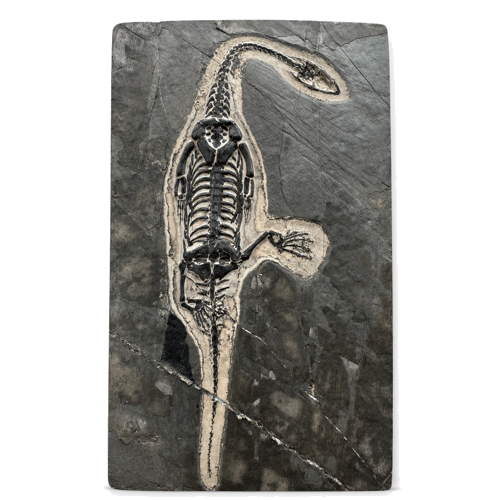
About the item: An authentic fossil of the marine reptile Keichousaurus from the Triassic period – a large and anatomically impressive artifact of prehistoric life formed during the Middle Triassic, Ladinian stage, approximately 242–237 million years ago in the territory of present-day China. This substantial specimen, measuring a full 20 cm in length, represents an extinct genus of reptiles from the family Pachypleurosauridae, whose remains are discovered in the rock layers of Guizhou Province. The fossil is characterized by a complete skeletal structure, striking graphic contrast, and natural quartz veins crossing the rock. This find is entirely authentic, without artificial enhancements, and reflects a unique evolutionary stage of the Mesozoic era.
Technical information:
Height: 20 cm.
Width: 11.1 cm.
Depth: 1.0 cm.
Weight: 660 g.
Origin: Guizhou Province, China.
Geological system: Mesozoic.
Period / Epoch: Triassic / Middle Triassic (Ladinian stage, 242–237 million years ago).
Condition: Natural bone structure, 100% authentic.
Treatment: The specimen was professionally prepared and cleaned using the acid washing method.
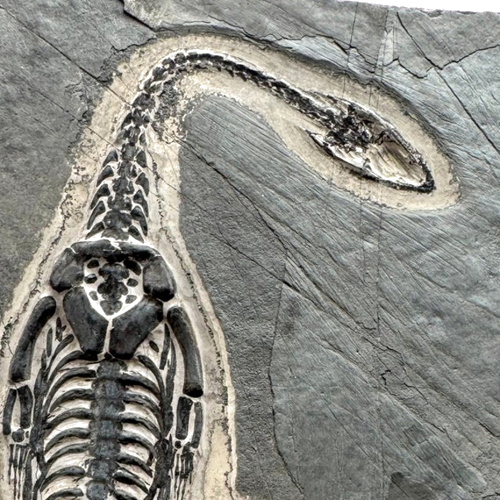
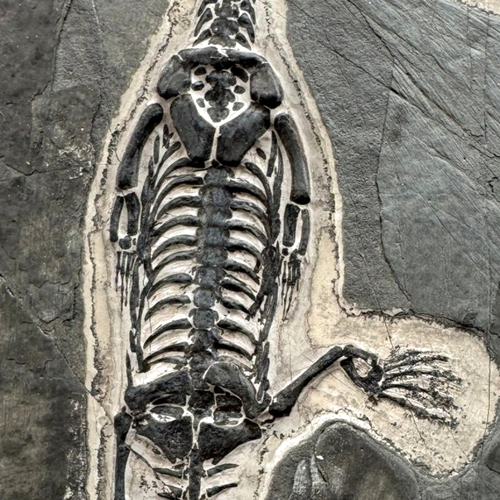
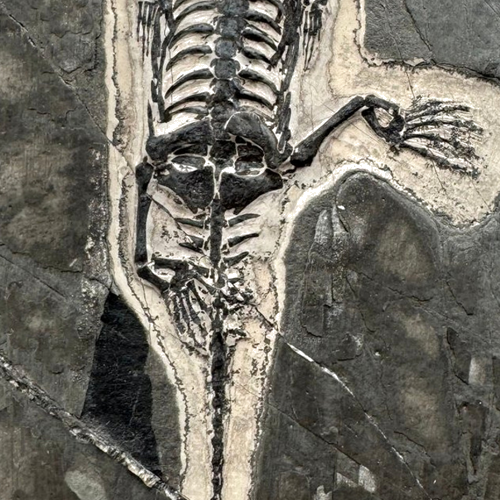
Structural and analytical breakdown: This excellently preserved specimen demonstrates an expressive, intact reptile skeleton, gracefully arranged within a rectangular slab of dark siltstone. The anatomy of the skeleton is revealed with particular detail: the elegantly curved long axis of the neck, the triangular skull, the dense rib cage, the vertebrae, and perfectly articulated forelimbs and hindlimbs with fine phalanges extending across the stone background are all clearly visible. Specialized acid-cleaning technology allowed for the precise removal of the upper sediment layer, exposing a three-dimensional dark bone relief that rises in stark contrast above the successfully cleaned matrix base. The light-colored lines crossing the bottom of the slab diagonally are natural quartz veins, testifying to the tectonic processes and mineralization that occurred within the rock over millions of years.
Historical and geographical context: Reptiles of the genus Keichousaurus were small, semi-aquatic animals that flourished in the shallow tropical lagoons and marine basins during the Middle Triassic period. Their dense, heavy bone structure helped regulate buoyancy while diving and hunting small fish and mollusks. This region in China, Guizhou Province, is today one of the world's most critical paleontological localities, where fine-grained sediments allowed for the ideal preservation of the vertebrae and delicate limb bones of these small sauropterygians, turning them into indispensable witnesses of early Mesozoic marine ecosystems.
Collectible and investment value: The market value of this substantial Keichousaurus specimen is defined by several key aspects. First and foremost is the representative 20 cm format and solid weight of 660 g – complete slabs of this size with fully expressed tail and head proportions are valued by collectors far more than small or fragmentary finds. The preparation quality is also highly critical, as the professional acid washing exposed maximum bone relief without any artificial coloring or masking. The natural quartz lines add further value, lending additional geological character and aesthetic charm to the slab. Finally, the object features universal applicability. Due to its visual impact, clear anatomical structure, and excellent appearance, this ancient relic will become an undeniable centerpiece in prestigious fossil collections, naturalistic interior decor, or luxurious cabinets of curiosities. This marine reptile skeleton, approximately 240 million years old, is an authentic document of prehistoric nature, blending evolutionary mystery, flawless master preparation, and a monumental appearance.