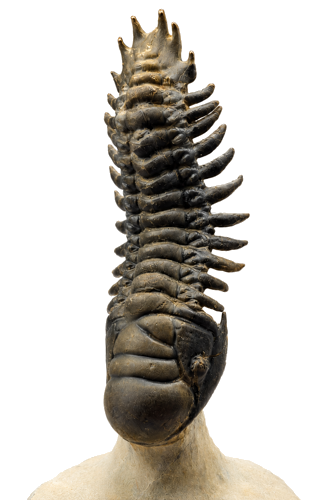
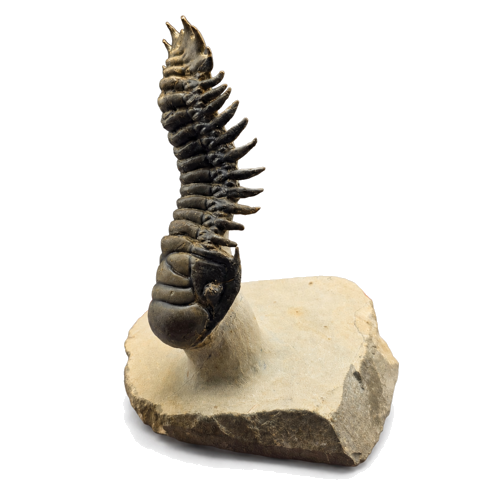
About the artifact: An authentic fossil of an extinct marine arthropod – the trilobite Crotalocephalina gibbosa (also referred to in the text as Crotacephalina) – from the Devonian period, demonstrating remarkable three-dimensional preservation and a highly valued dynamic display. This 10 cm high and 8 cm wide specimen, discovered in the sedimentary rocks of Morocco, represents the Cheiruridae family of trilobites that flourished in the planet's oceans hundreds of millions of years ago. The fossil stands out for its complete originality, natural condition without obvious restorations, and highly sculptural paleontological preparation. Due to its unique vertical position on the rock matrix and excellent anatomical integrity, this find possesses great scientific value and exceptional aesthetic appeal in the antique market.
Technical information:
Height: 10 cm
Width: 8 cm
Origin: Morocco
Geological system: Paleozoic
Period: Devonian (419.2–358.9 million years)
Condition: Natural, without obvious reconstructions
Scientific name: Crotalocephalina gibbosa (syn. Crotacephalina gibbosa)
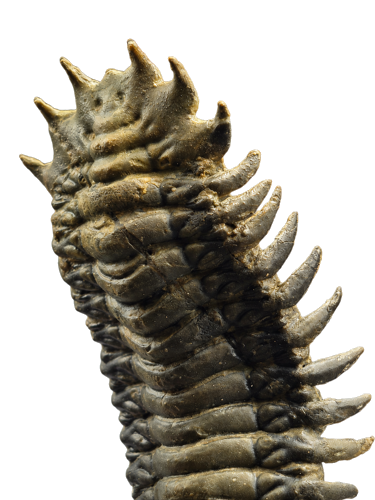
Artistic and structural analysis: This fine specimen demonstrates an extraordinary three-dimensional preparation technique, with the trilobite freed from the rock as if stretching vertically or rising from its base. Anatomically, the powerful exoskeleton has retained flawless detail: individual deep thoracic segments with gracefully curved pleural spines, a smooth and compact cephalon (head shield), and a rounded pygidium (tail shield) perfectly tucked against the head area are clearly visible. The dark, natural color of the fossil creates a very vivid, graphic contrast with the light sedimentary rock matrix on which the body rests. Professional and meticulous hand-cleaning has brought out the three-dimensional relief of the segments without altering the original contours of the carapace.
Historical and geographical context: Trilobites of the genus Crotalocephalina were specialized inhabitants of the Devonian period, characterized by their distinctive exoskeleton segmentation and long, sharp pleural spines. These spines performed an important hydrodynamic and protective function in the oceans of the Paleozoic era, where the first predatory fish and large cephalopods were rapidly evolving at the time. The desert regions of Morocco are globally recognized as the most important chronicle of the Devonian epoch – the mineral layers formed here allowed the soft seabed mud to instantly preserve the animals in their natural positions, safeguarding the unique architecture of Paleozoic marine life.
Collectible and investment significance: The market value of this trilobite is defined by several essential aspects. First and foremost is the visual presentation – specimens prepared vertically on a natural rock stem, requiring hundreds of hours of painstaking work under a microscope, are far rarer and more desirable than flat finds. The solid 10x8 cm format is also valuable, allowing for a detailed analysis of the segmental structure and making the object highly visible in displays. The natural condition without chemical modifications or reconstructions adds to its value, guaranteeing a stable price in the modern paleontology market. Finally, the object boasts high prestige, making it an undeniable highlight of academic fossil collections, a valuable addition to serious cabinets of curiosities, or a prestigious interior detail.
This Paleozoic masterpiece, approximately 400 million years old, is an authentic document of ancient ocean history, harmoniously combining anatomical uniqueness, the natural beauty of the rock, and long-term antique value.