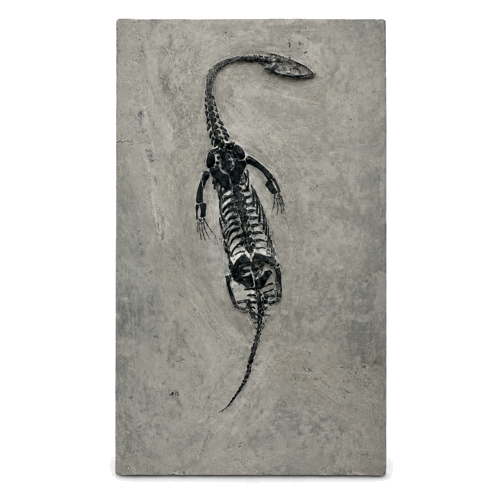
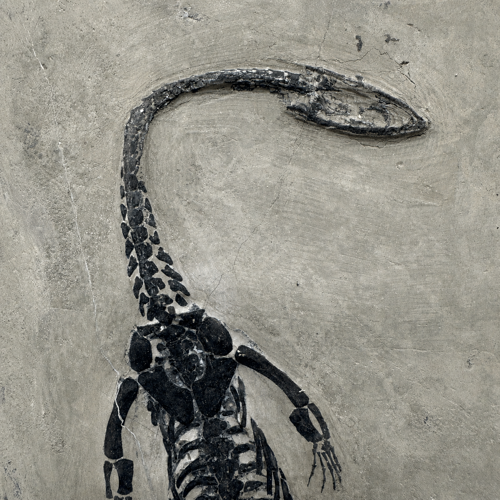
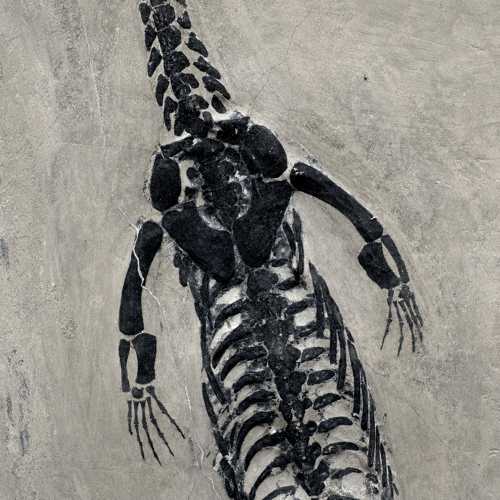
About the artifact: An authentic marine reptile fossil of the genus Keichousaurus from the Triassic period – an exceptional artifact of prehistoric life, formed 251.9–201.3 million years ago in the present-day territory of China. This specimen represents an extinct genus of the order Sauropterygia, preserved in a natural rock matrix. The fossil stands out for its complete, anatomically articulated skeletal structure, a gracefully curved neck axis, and clear visibility of details. Valued for its complete authenticity without artificial coloring and subtle natural quartz veinlets, this find possesses solid aesthetic value and strong collectible appeal.
Technical information:
Height: 17.5 cm
Width: 10.5 cm
Depth: 1.3 cm
Origin: China (Guizhou Province)
Geological system: Mesozoic
Period: Triassic (251.9–201.3 million years)
Condition: Natural, full articulated skeleton (the length of the extended animal would reach about 18 cm) Conservation: Stabilized, ready for display
Artistic and structural analysis: This specimen demonstrates a complete marine reptile skeleton from the ventral (abdominal) side, retaining a coherent biological architecture. A clearly articulated anatomical structure: a chain of vertebrae, symmetrical rib cages, pelvic bones, the tail axis, and gracefully splayed phalanges of the forelimbs and hindlimbs. The skeletal proportions and the structure of the rib cage allow identifying that this is a female individual. The dark skeleton naturally contrasts with the smoother grey background of the rock matrix, and the composition is subtly complemented by natural white quartz lines, testifying to an authentic geological vein formation.
Historical and geographical context: The genus Keichousaurus was named after Guizhou Province (formerly spelled Kweichow) in China, where the first traces of these animals were discovered in 1957. These small marine reptiles belonged to the family Pachypleurosauridae and dominated the shallow tropical waters of the Triassic period, completely disappearing during the Triassic–Jurassic mass extinction. They provide invaluable information about the evolution of ancient marine ecosystems and the adaptation of reptiles to an aquatic lifestyle.
Collectible and investment significance: The market value of this specimen is defined by several essential aspects. First and foremost is the completeness of the anatomy – the female skeleton gracefully curved in a natural S-shape, with all four limbs and the skull, creates a very dynamic image. Complete authenticity is also valuable, as the natural condition of the rock and bone is maintained without any artificial reconstructions or coloring. Exceptional decorativeness adds to its value, as subtle quartz lines give the stone additional aesthetic character. Finally, the object boasts versatility, as its convenient format makes it an ideal choice for fossil collections, naturalistic home decor, cabinets of curiosities, or educational projects.
This Mesozoic era relic, over 200 million years old, is an authentic document of prehistoric nature, harmoniously combining scientific weight, elegant aesthetics, and long-term collectible potential.