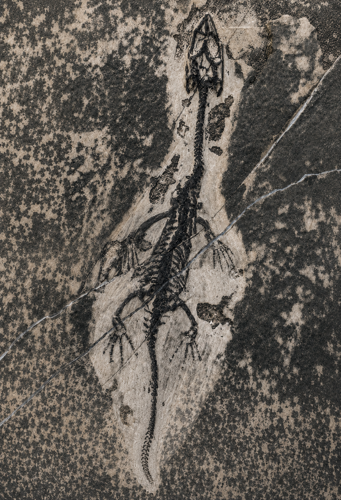
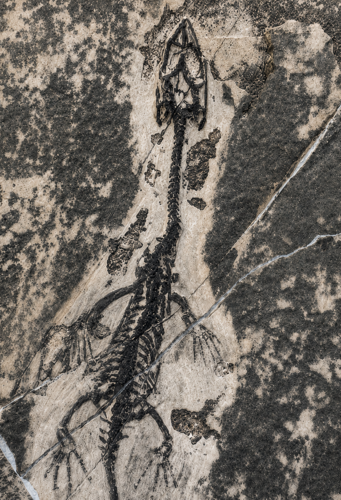
About the artifact: An authentic marine reptile fossil of the genus Keichousaurus from the Triassic period – a delicate artifact of prehistoric life, formed in the Middle Triassic, Ladinian age, approximately 242–237 million years ago. This specimen represents an extinct genus of reptiles from the Pachypleurosauridae family, whose remains are found in rock layers in China, especially in Guizhou Province. The small, compact format find retains its natural skeletal structure, boasts 100% authenticity without artificial coloring, and represents a unique evolutionary stage of the Mesozoic era.
Technical information:
Height: 6.2 cm
Width: 4.1 cm
Depth: 0.9 cm
Weight: 58 g
Origin: Asia (China, Guizhou Province)
Geological system: Mesozoic
Period/Epoch: Triassic / Middle Triassic (Ladinian age, 242–237 million years ago)
Condition: Natural bone structure, structural reinforcement applied
Stabilization: A natural crack in the rock was professionally repaired, and an additional stone plate of the same material was glued to the back of the slab to increase the stability and durability of the specimen
Artistic and structural analysis: This specimen demonstrates a miniature, elongated marine reptile skeleton preserved in a dark rock matrix. The composition highlights the elongated neck axis, a triangular skull, the spinal line, and symmetrically arranged limbs with clearly visible tiny phalanges. The dark silhouette of the skeleton naturally emerges against the lighter, textured rock background, creating an authentic geological contrast. The natural fracture line running diagonally across the matrix plane has been stabilized, completely preserving the original anatomy of the find and the rock pattern without changing the color or texture of the object.
Historical and geographical context: Reptiles of the genus Keichousaurus were small, semi-aquatic animals that flourished in shallow tropical water basins during the Middle Triassic period. Their dense bone structure (pachyostosis) helped regulate buoyancy while diving and hunting for small fish and mollusks. This region in China, Guizhou Province, is today one of the world's most important paleontological sites, where fine-grained sediments allowed for the ideal preservation of the vertebrae and delicate limb bones of these small sauropterygians, turning them into indispensable witnesses of early Mesozoic marine ecosystems.
Collectible and investment significance: The value of this compact Keichousaurus specimen in the antique market is defined by several essential aspects. First and foremost is the complete authenticity of the bone without industrial coloring or artificial line drawing, which guarantees the scientific validity of the object. Also highly important is the structural preparation, as the reinforcement performed on the back side with an identical rock plate ensures that the fragile specimen is protected from weathering and prepared for long-term storage. The convenient, miniature format adds to its value, allowing the find to be easily integrated into limited display spaces. Finally, the object boasts versatile application, making it ideal for supplementing beginner fossil collections, naturalistic interior decor, traditional cabinets of curiosities, or scientific and educational school projects.
This Mesozoic era relic, approximately 240 million years old, is an authentic document of prehistoric nature, harmoniously combining evolutionary insight, natural structure, and accessible collectible potential.