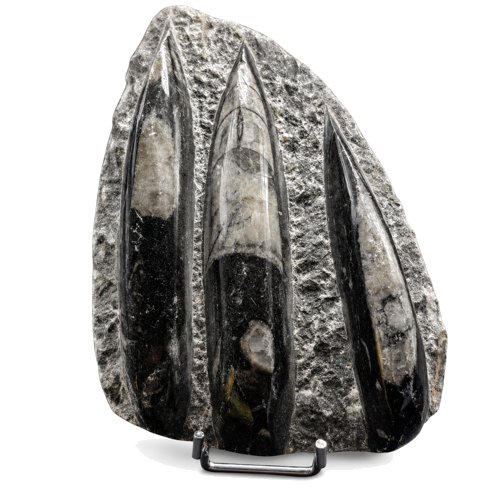
About the item: An authentic fossil slab of the extinct cephalopod mollusks Orthoceras from the Ordovician period – a powerful and aesthetic specimen of paleofauna formed 485.4–443.8 million years ago in ancient oceans, located in present-day northwestern Sahara, Morocco. These animals were among the first complex life forms to inhabit our planet. The name, meaning "straight horn," perfectly describes their conical, elongated shells, which fossilized within the dark rock over millions of years of geological processes. Valued for its excellent preservation of natural structures, masterful polishing, and deep visual contrast, this multi-specimen set is a precious witness to the evolution of Earth's ecosystems.
Technical Information:
Height: 11 cm
Origin: Northwestern Sahara, Morocco
Geological system: Paleozoic Period: Ordovician (485.4–443.8 million years) Number of specimens: A slab with three distinct individuals Condition: Natural, primary matrix Preparation: Professionally cleaned and polished
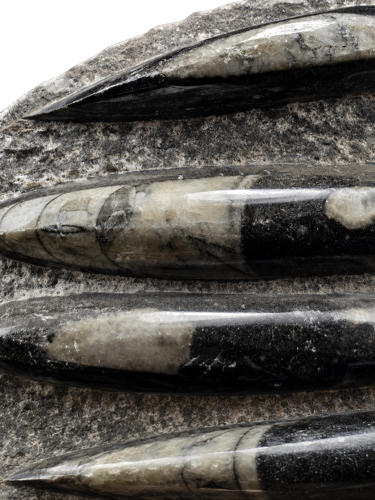
Artistic and Structural Analysis: This stone slab displays three parallel, elongated Orthoceras shells emerging from a rugged, unrefined rock matrix. The animals' original shells were composed of aragonite, which was replaced by dark and light crystalline minerals over hundreds of millions of years of sedimentation and mineralization. The surface has undergone meticulous, mirror-like polishing thataccentuates the deep black and greyish-white mineral color palette alongside the internal structure of the shells. The anatomical components are beautifully visible: the transverse partitions (septa) that divided the shell into separate chambers, and the connecting tube (siphuncle). The contrast between the smooth, lustrous surface of the fossilized mollusks and the grey, textured rock base lends the composition a sculptural quality and powerful aesthetic dynamism.
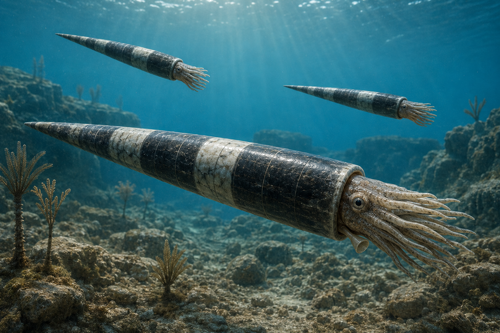
Historical and Geographical Context: Orthoceras mollusks flourished in the oceans during the Ordovician and Silurian periods, long before the appearance of the first dinosaurs. These predators moved through the water by expelling water from their shell chambers, and their straight, horn-like shape provided excellent hydrodynamics. The northwestern Sahara region of Morocco is a world-renowned paleontological site – a warm, shallow ocean once covered this area, and the bodies of the mollusks settling on its floor were buried by sand and mud, eventually transforming into unique stone matrices. Studying such fossils allows scientists to reconstruct ancient marine ecosystems, comprehend animal adaptation, and trace global climate shifts that shaped the surface of the Earth.
Collectible and Investment Value: The market value of this Orthoceras fossil slab is defined by several essential aspects. First is the multi-specimen composition – three symmetrically and aesthetically arranged individuals on a single slab are visually more compelling and rarer than single, isolated finds. The flawless quality of preparation is equally valuable, as professional polishing achieves a three-dimensional depth effect without compromising the fragile structure of the chambers. Its enduring popularity further enhances its value, since early Paleozoic relics with clear anatomical legibility remain one of the most sought-after subjects for both novice and advanced collectors. Finally, the object features universal utility; due to its harmonious natural colors, graphic quality, and practical 11 cm size, this slab is ideal for fossil collections, naturalistic interior decor, or cabinets of curiosities.
This is an nearly half-billion-year-old relic of the deep ocean – an authentic monument of prehistoric nature, harmoniously merging scientific weight, the natural beauty of minerals, and long-term collectible potential.