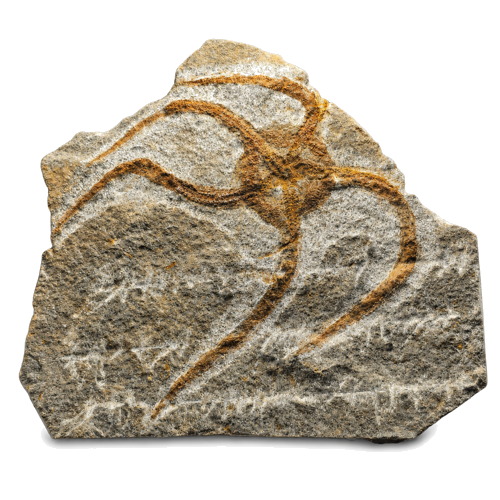
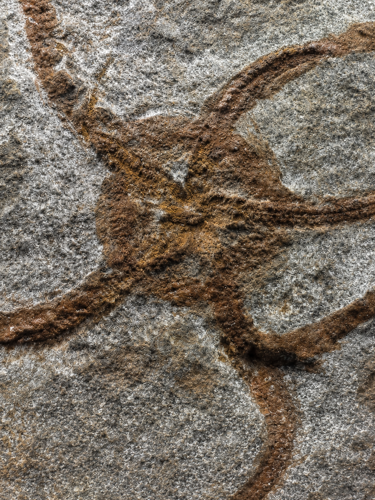
About the item: An authentic echinoderm fossil from the Ordovician period – a unique and highly visual artifact of prehistoric marine life, formed 485.4–443.8 million years ago in present-day Morocco. Discovered in the northwestern Sahara, this find represents early marine ecosystems. Although historically these animals are often referred to simply as starfish in common language, morphologically this specimen, typical of Moroccan localities, with its disc-shaped body and long, thin, radially arranged arms, represents brittle stars (class Ophiuroidea, genus Ophiura). Since these animals have existed in Earth's oceans with minimal anatomical changes for nearly half a billion years, they are rightfully considered classic examples of "living fossils." Valued for its expressive, dynamic composition and excellent contrast, this fossil holds a stable, enduring value.
Technical Information:
Height: 12 cm
Origin: Northwestern Sahara, Morocco
Geological system: Paleozoic
Period: Ordovician (485.4–443.8 million years)
Condition: Enhanced
Preparation: Conserved and stabilized
Artistic and Structural Analysis: This stone slab showcases a gracefully arranged silhouette of a brittle star, naturally embedded within the matrix of a grey rock base. The body features a central disc from which long, thin, and wavy arms extend radially, creating the impression of fluid, dancing movement captured within the hardened rock. Because natural echinoderm fossils of this age are often faint due to the specific nature of the rock strata, this specimen has been professionally enhanced to bring out maximum anatomical detail and clarity. The vivid, brownish-orange (ferruginous) outline of the animal provides a wonderful graphic contrast against the lighter, roughly-textured sandstone background, turning the fossil into an aesthetically appealing piece of art.
Historical and Geographical Context: During the Ordovician period, when global sea levels reached one of their highest points in the Paleozoic era and water temperatures in tropical seas exceeded 43°C (110°F) in places, the oceans experienced a massive diversification and boom in animal life. It was under these extreme, warm conditions that true starfish (Asteroidea) and brittle stars (Ophiuroidea) definitively diverged within marine fauna. While true starfish utilized numerous tube feet for locomotion, brittle stars evolved to rely on their flexible, narrow arms, which allowed them to actively navigate the ancient ocean floor. The Sahara Desert in Morocco stands today as one of the world's richest paleontological time capsules from this period.
Collectible and Investment Value: The market value of this specimen is defined by several key aspects. First is its visual expressiveness, as the undulating arrangement of the arms creates a highly dynamic and aesthetically pleasing composition that is intensely sought after by collectors. Its stable condition is equally valuable, as the paleontological conservation performed ensures the strength of the stone and protects the fragile fossil layer from weathering. The sheer historical depth enhances its value further, as a nearly 450-million-year-old animal is not merely a decorative piece, but an invaluable document of Earth's evolution. Finally, the object features universal appeal; due to its practical 12 cm format, clean lines, and natural base, this piece will perfectly complement systematic fossil collections, adorn private studies, or become an exceptional accent in a modern interior.
This echinoderm relic from the Ordovician period is an authentic witness to the prehistoric world, where the geological history of the oceans, evolutionary stability, and graceful aesthetics create long-term collectible and educational potential.