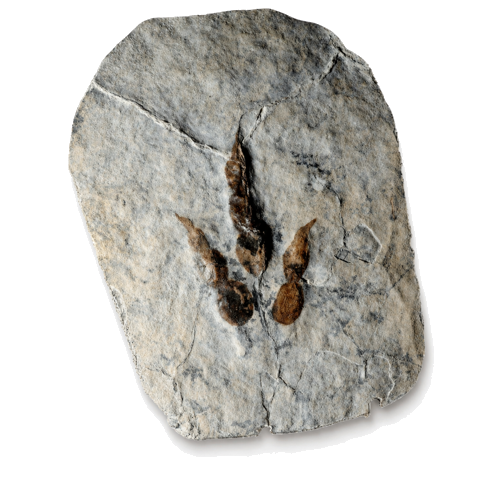
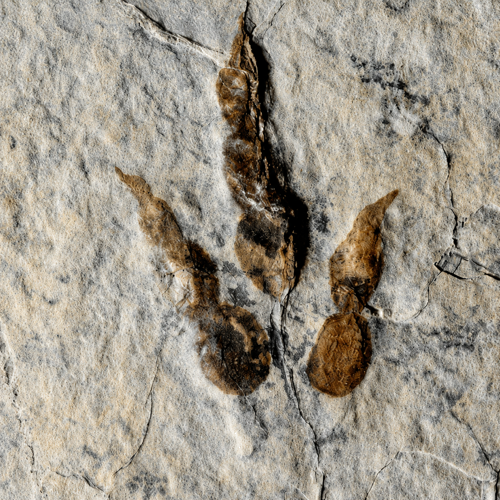

About the item: An authentic theropod dinosaur footprint (Grallator) on a rock slab from the Jurassic period – an incredible paleontological artifact formed 201.3–145 million years ago in the territory of modern-day France. This find represents the trackway of a tridactyl (three-toed) predatory dinosaur, preserved within a natural sedimentary matrix. The specimen is distinguished by its exceptional depth, clarity, and particularly rare morphological features – with a grainy skin texture visible in places. Valued for its weight in scientific history and museum-grade preservation, this footprint possesses immense visual and collectible appeal.
Technical Information:
Footprint size: approx. 13 cm
Origin: France
Geological system: Mesozoic
Period: Jurassic (201.3–145 million years)
Condition: Natural
Conservation: Coated with a thin, easily removable layer of wax to enhance the relief
Artistic and Structural Analysis: This specimen showcases an anatomically perfect, deep, and clearly articulated Grallator-type footprint on a greyish limestone slab. The classic three-toed structure characteristic of theropods is highly visible, featuring tapered claw tips and footprint pad segmentation. The warm, brownish tone of the footprint itself creates an excellent color contrast with the lighter matrix. A unique feature of this find is its remarkable depth and the surviving microscopic texture fragments of the skin covering (relief), which are exceedingly rare in fossils. To emphasize the three-dimensional depth of the anatomical lines, the surface has been subtly coated with a thin layer of wax, which can be easily cleaned off if desired.
Historical and Geographical Context: Grallator is an early-to-mid Mesozoic ichnogenus (a classification designated for tracks left by animals rather than bone remains) attributed to small, bipedal predatory dinosaurs known as theropods. During the Jurassic period, the regions of modern-day France were covered with shallow lakes and lagoons, surrounded by shores of soft sand and mud where these animals left their tracks as they moved. Quickly covered by fine sediments and fossilized over millions of years, these footprints (ichnofossils) provide scientists with invaluable information regarding dinosaur biomechanics, movement speed, behavior, and ancient ecosystems.
Collectible and Investment Value: The market value of this dinosaur footprint is defined by the following exceptional criteria:
Rarity – dinosaur tracks with surviving skin texture and deep relief are a paleontological rarity, with demand steadily growing at auctions.
Anatomical clarity – a complete, tridactyl print with clearly identifiable contours of the phalanges and claws.
European origin – French Jurassic localities are highly esteemed for their historical status and flawless sedimentation quality.
Emotional and aesthetic impact – this is a direct testament to the step of a living dinosaur, a moment frozen in stone that, due to its dynamic form, functions as a monumental work of art.
This is an over 150-million-year-old relic of the Mesozoic Era – a prehistoric document of museum value, merging the highest scientific weight, unique preservation, and long-term collectible and investment potential.