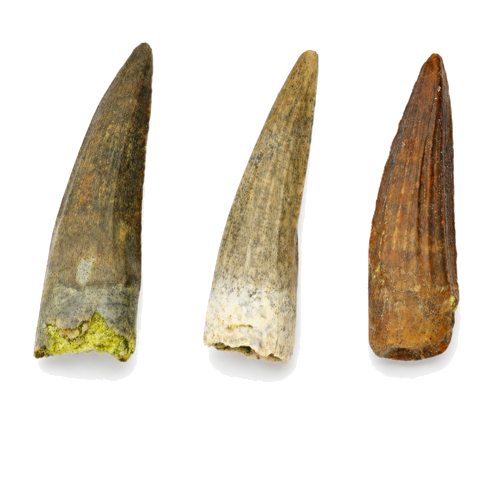
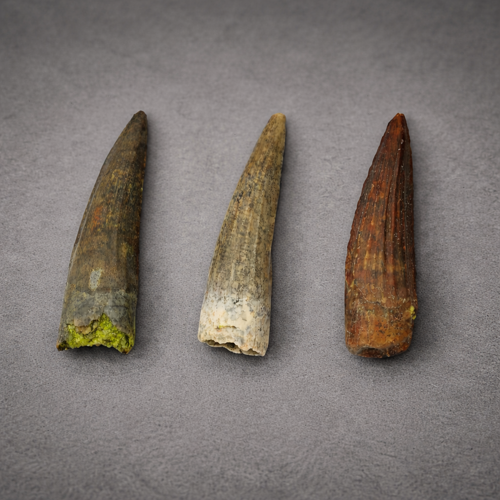
About the item: This set of three fossil teeth belongs to Suchomimus tenerensis – a predatory theropod of the spinosaurid family that lived during the Early Cretaceous period, approximately 113 million years ago, in the territory of present-day Niger. The fossils were discovered in the Erlhaz Formation, one of Africa's most significant paleontological sites. These fossils are authentic biological relics preserved from the time when dinosaurs ruled the Earth's ecosystems. Over millions of years, the process of mineralization replaced the organic structure of the tooth with minerals while preserving the original shape and microtexture, making each tooth a direct biological fragment of an extinct species.
Technical Information:
Title: Fossil dinosaur teeth (set)
Species: Suchomimus tenerensis
Period: Early Cretaceous (~113 million years, Aptian–Albian stage)
Region: Gadoufaoua region, Ténéré Desert, Niger Formation: Erlhaz Formation
Material: Natural fossil enamel, mineralized tissue
Technique: Natural fossilization
Number of specimens: 3 teeth Length of the largest tooth: ~3 cm
Morphology: Conical teeth with longitudinal enamel ridges
Condition: Natural, without restoration, with partially preserved roots
Classification: Spinosauridae family, baryonychinae group
Artistic Analysis: The set consists of three teeth that have retained the characteristic spinosaurid morphology – an elongated conical shape and distinct longitudinal enamel ridges. Such a structure not only increased the mechanical strength of the tooth but also helped in gripping prey. The teeth feature a natural surface with the original microtexture preserved, and their conical shape creates a monumental, predatory aesthetic even in a small format. These are aesthetically attractive collector's items where natural processes over millions of years have formed a unique color palette and surface plasticity.
Social and Cultural Context: Suchomimus was a large dinosaur, growing up to 10–11 meters in length, belonging to the spinosaurids – a group that evolutionarily adapted to a semi-aquatic lifestyle. Its skull resembled a crocodile's snout, and its teeth were specialized for fishing, making Suchomimus one of the earliest specialized fish-eaters among the large theropods. In the world of science and collecting, such objects offer a direct connection to prehistoric life. Suchomimus fossils are found much less frequently than finds of later spinosaurids, making these teeth highly valued as geologically important and rare specimens.
Provenance: The fossils were found in the Gadoufaoua region, Ténéré Desert, Niger, in the Erlhaz Formation. These are authentic and original finds representing one of Earth's oldest ecosystems. Such specimens naturally attract the attention of paleontology enthusiasts and become an exceptional highlight of any private or institutional natural history collection.