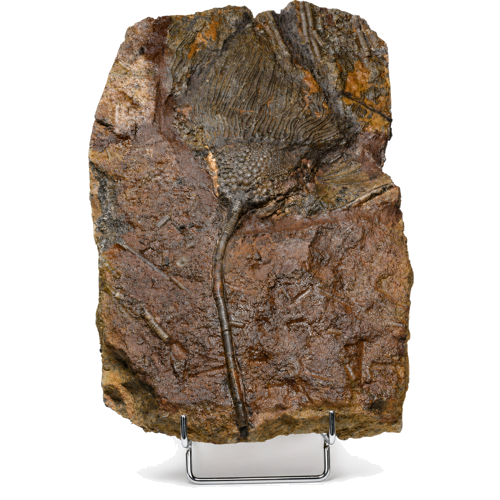
About the item: An authentic fossil of the sea lily – the echinoderm Scyphocrinites elegans – from the Silurian period, representing one of the most elegant and visually stunning forms of ancient marine fauna in Earth's history. This substantial specimen, measuring approximately 30 cm in height and 19 cm in width, originates from the famous Paleozoic sedimentary layers of Morocco. This decorative stone slab stands out for its clearly defined three-dimensional skeletal structure, excellent visibility of the main anatomical parts, and the deep colorful character of the rock. Valued both for its scientific weight and its exceptional design potential, this fossil is a prime example of the archaic evolution of marine ecosystems.
Technical information:
Height: 30 cm.
Width: 19 cm.
Depth: 6 cm.
Weight: 3.1 kg.
Origin: Morocco.
Geological system: Paleozoic.
Period / Epoch: Silurian (443.8–419.2 million years ago).
Scientific name: Scyphocrinites elegans.
Condition and treatment: Mechanically cleaned and professionally stabilized rock to highlight and protect the fragile parts of the skeleton.
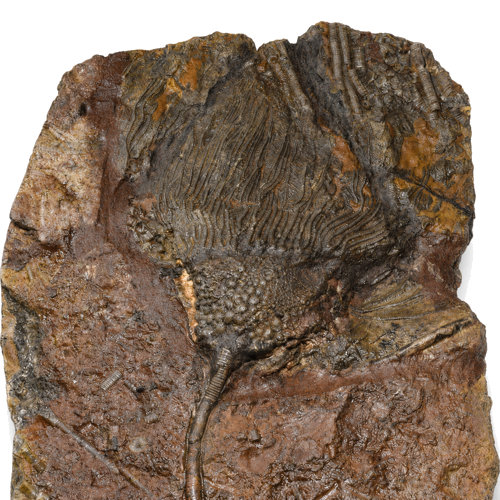
Structural and analytical breakdown: This heavy stone slab demonstrates a beautifully preserved sea lily crown dominating the upper section of the matrix, from which a long, segmented stem extends downward across the entire stone mass. The anatomical structure is revealed in high detail: the dense, textured calyx area and the thin, graceful pinnate arms branching out from it for filter-feeding are clearly visible. The stem is composed of disk-shaped columnals forming a distinct segmented axis. The rock features a rich, warm brown and ferruginous ochre color palette, while the fossilized parts of the animal itself stand out in darker, more graphic tones. Since the natural details of sea lilies in sediments are often fragile and hidden, the specimen was professionally prepared by stabilizing the rock matrix and enhancing the relief contours.
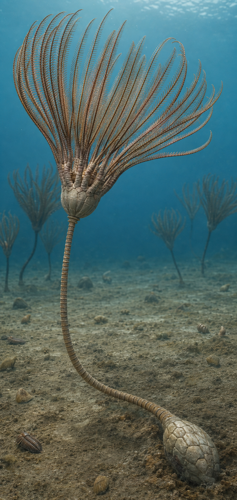
Historical and geographical context: Sea lilies of the genus Scyphocrinites flourished during the Late Silurian and Early Devonian periods, over 420 million years ago. Although these creatures resemble plants in appearance, they are true marine animals, echinoderms, related to starfish and sea urchins. Unlike most other crinoids that anchored themselves to the seafloor with their stems, Scyphocrinites possessed a unique adaptation – a hollow, root-supported spherical float called a lobolith formed at the end of their stem, allowing the entire colony to drift freely in the water column. The deposits of the Erfoud and Alnif regions in Morocco are a world-renowned phenomenon, where the mud of ancient Paleozoic seas ideally preserved these fragile, graceful beings.
Collectible and investment value: The market value of this Scyphocrinites elegans fossil is defined by several key aspects. First and foremost is the substantial, representative format, as a slab 30 cm high and weighing over 3 kg with a fully expressed calyx and long stem line holds far greater value than small stem fragments. The high decorative quality is also critical, since the combination of warm stone tones and a sculptural skeleton transforms this exhibit into an exceptional aesthetic object. The classic status of this taxon further adds to its value, as these sea lilies remain one of the most highly sought-after and recognizable paleontology subjects on the international market. Finally, the object features universal applicability, because due to its natural elegance, monumentality, and the included display stand, this slab is ideal for systematic fossil collections, luxurious cabinets of curiosities, or as a primary naturalist art centerpiece in a modern interior. This Paleozoic era masterpiece, approximately 430 million years old, is an authentic document of the ancient oceans' spirit, harmoniously combining scientific weight, sculptural natural beauty, and long-term collectible potential.