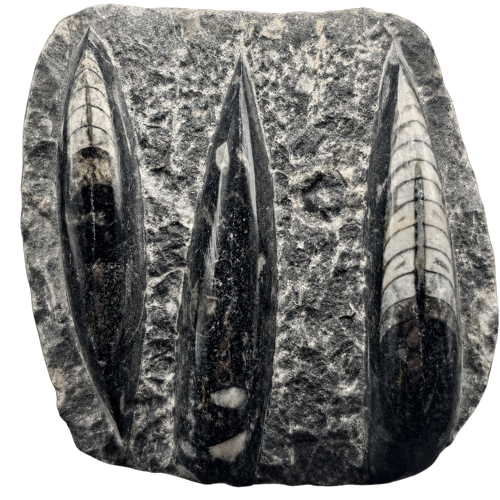
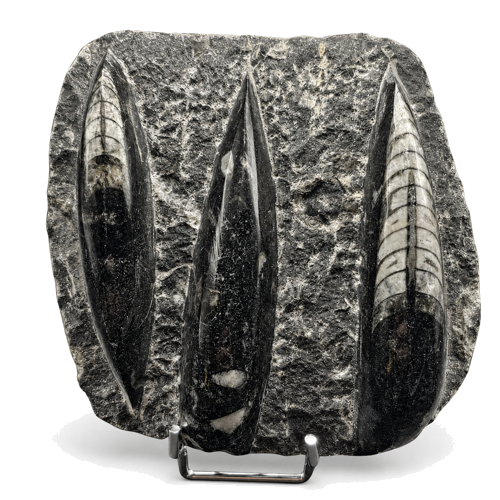
About the artifact: An authentic composition of several cephalopod fossils of the genus Orthoceras in a rock slab from the Ordovician period – a unique geological artifact formed 485.4–443.8 million years ago in the northwestern part of the Sahara Desert, in the present-day territory of Morocco. These are remnants of some of the oldest life forms on the planet, preserved in a natural matrix. Valued for its excellent preservation, aesthetic contrast, and scientific significance, this fossil slab possesses exceptional visual appeal and is ideal for both interior decor and collections.
Technical information:
Height: 9 cm
Origin: Northwestern Sahara, Morocco
Geological system: Paleozoic era
Period: Ordovician (485.4–443.8 million years)
Condition: Natural matrix, fossils are polished
Conservation: Stabilized, ready for display
Artistic and structural analysis: This specimen presents an aesthetic composition of several Orthoceras individuals on a single rock slab. Since the shells have been professionally polished, the bright internal chambers filled with calcite and aragonite mineralization, along with the separating partitions (septa), stand out in sharp contrast against the dark, almost black background. The characteristic conical, elongated "straight horn" shape and the longitudinal line of the siphuncle are clearly visible, allowing for a detailed analysis of the internal anatomy and protective shell structure of these ancient mollusks. The contrast between the rough, natural grey texture of the matrix and the smooth, glossy surface of the polished fossils creates a dynamic visual impression.
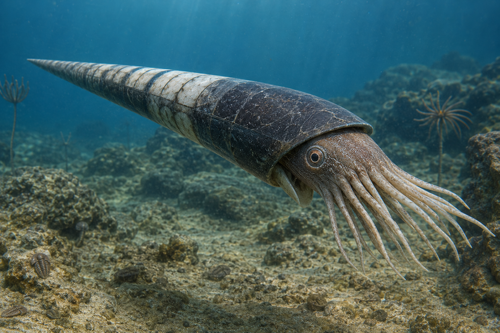
Historical and geographical context: Orthoceras (Greek for "straight horn") is an extinct order of mollusks that flourished in the tropical seas of the Paleozoic era, particularly during the Ordovician and Silurian periods, when the current territory of the Sahara was a deep ocean floor. These animals were active predators that moved through the water using jet propulsion and regulated their buoyancy through the ratio of gas and fluid within their chambers. The Moroccan desert deposits are world-renowned precisely for the abundance of these mollusk fossils and an incredibly high-quality sedimentation process that turned fragile shells into solid stone.
Collectible and investment significance: The market value of this fossil slab is defined by several essential aspects. First and foremost is the aesthetic composition – several specimens of different sizes naturally arranged on a single slab create a complete, natural picture. The contrasting finish is also valuable, as high-quality polishing maximizes the visibility of the internal chamber structures while maintaining the natural rock base. The historical depth adds to its value, representing a testament to life from nearly half a billion years ago, making it one of the oldest available fossil forms on the market. Finally, the object boasts versatility, as its attractive shape and compact 9 cm dimensions make it highly appreciated not only by paleontology enthusiasts but also by modern interior designers.
This impressive relic of the deep seas, over 440 million years old, is an authentic document of prehistory, harmoniously combining scientific value, elegant aesthetics, and classic collectible appeal.