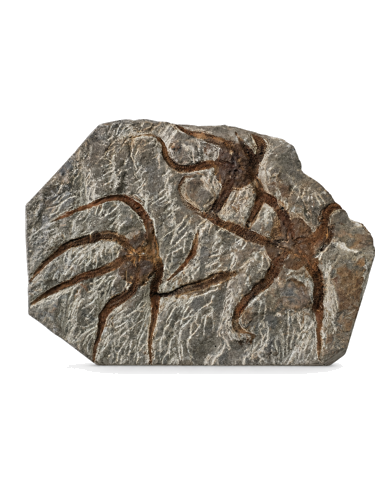
About the artifact: An authentic composition of fossils of several brittle stars (Ophiuroidea) – relatives of starfish – on a rock plate from the Ordovician period. This is a unique and representative geological artifact formed 485.4–443.8 million years ago in the northwestern part of the Sahara Desert, in the territory of present-day Morocco. This large specimen of the phylum Echinodermata contains a natural accumulation of prehistoric organisms from the period when the first complex ocean ecosystems were forming. Valued for its larger format, dense multi-specimen composition, and scientific significance, this fossil slab features exceptionally strong visual appeal and outstanding aesthetic value.
Technical information:
Height: 20 cm
Width: 14 cm
Origin: Northwestern Sahara, Morocco
Geological system: Paleozoic era
Period: Ordovician (485.4–443.8 million years)
Condition: Enhanced – natural contours optically highlighted for a better visual effect
Conservation: Stabilized, fully ready for display
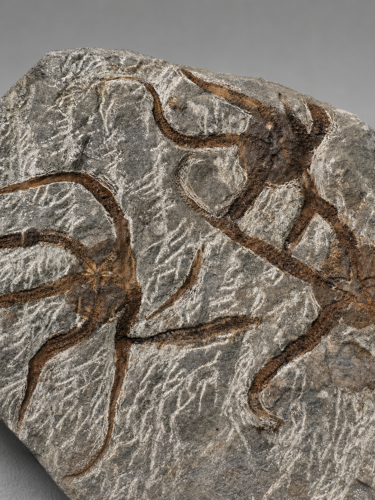
Artistic and structural analysis: This specimen stands out for its large rock plate, naturally concentrating several brittle stars (ofiūros). Each individual features a well-defined, disc-shaped central body from which long, graceful, and flexible arms (limbs) open radially. The deep, dark brown and ochre relief of the fossils creates a sharp contrast with the lighter, textured matrix of the grey limestone. The intertwined, wavy limbs of the brittle stars create a highly dynamic and vivid impression of movement in the rock – like an ancient dance of the ocean floor captured in stone.
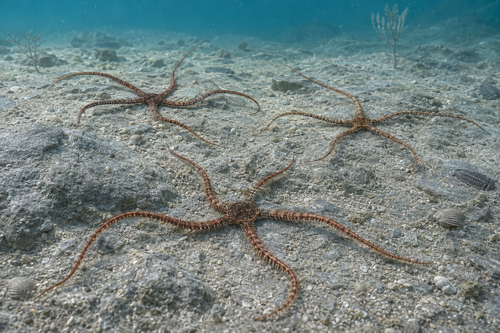
Historical and geographical context: During the Ordovician period, in the Paleozoic era, Earth's ocean levels reached one of their highest points, and tropical sea temperatures exceeded 43 °C (110 °F). These exceptional conditions led to a mass diversification of marine life, during which true starfish (Asteroidea) and brittle stars (Ophiuroidea) diverged. At that time, the territory of present-day Morocco was the floor of a shallow, life-teeming ocean. These animals used their flexible arms for active movement, and their ability to survive with minimal anatomical changes to the present day makes them classic examples of "living fossils."
Collectible and investment significance: The market value of this large echinoderm fossil slab is defined by several essential criteria. Abundance of the composition – several different individuals naturally arranged on a single 20x14 cm plate create a coherent, rich picture of a prehistoric marine ecosystem. Evolutionary weight – it represents a half-billion-year-old life form, valued by both paleontologists and science enthusiasts. Visual aesthetics – the powerful sculptural contrast of brown silhouettes against a grey base provides the object with exceptional decorativeness. Museum versatility – due to its solid format, the specimen is ideal for both specialized collections and as an exclusive accent in luxury interiors. This impressive witness of Earth's history, nearly 450 million years old, is an authentic relic harmoniously combining undeniable scientific importance, a monumental aesthetic view, and long-term collectible potential.