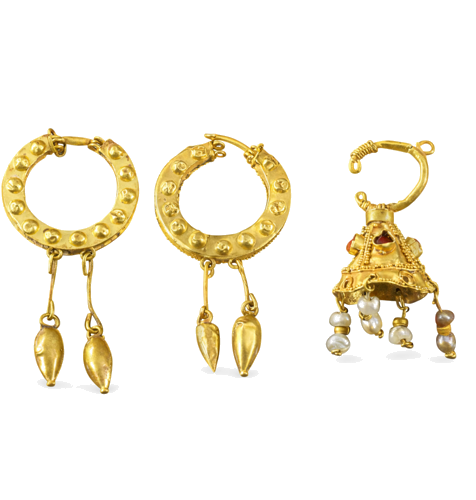
About the item: An exceptional set of ancient gold earrings consisting of three authentic specimens – one matched pair of earrings and one single earring. The set represents two different jewelry traditions of the ancient world – West Asia of the 1st millennium BC and the Parthian Kingdom of the 1st–2nd century AD. These items reflect the high craftsmanship of ancient goldsmiths, featuring meticulously executed granulation and twisted gold wire decor, while one earring is additionally adorned with carnelian inlays and glass bead pendants. Due to its authenticity and good state of preservation, this set possesses great historical, archaeological, and collectible value.
Technical Information: The set consists of three gold earrings (3 pcs.), structurally divided into two parts. The first object is an authentic pair of gold earrings, with a total weight of 5.82 g, and the length of each earring is 4.6 cm. Place of origin – West Asia, dating to the 1st millennium BC. These are hoop earrings with a hinge closure, decorated with relief hemispherical protrusions, precise granulation, and wire ornament, with two moving spindle-shaped pendants attached at the bottom. The condition of this pair is good (the complete, undamaged construction is preserved). The second object is a single gold earring, with a weight of 3.25 g and a length of 3.6 cm. Place of origin – Parthian Kingdom, dating to the 1st–2nd century AD. This is a hoop earring with a bell-shaped pendant, decorated with granulation, natural carnelian inlays, and glass bead pendants. Its condition is assessed as good antiquarian (some of the original glass bead pendants are missing).
Artistic and Structural Analysis: This set provides insight into two different ancient jewelry traditions. The West Asian pair of earrings stands out for its clear geometric composition and harmonious proportions. The sturdy hoops are decorated with relief hemispherical protrusions, and on the opposite side, with subtle granulation and a pseudo-twisted wire ornament. The spindle-shaped pendants attached at the lower part provide the ornaments with additional lightness and plastic movement. Meanwhile, the Parthian period earring features a more complex, architectural composition. Its bell-shaped pendant is decorated with fine granulation details and carnelian inlays, while the glass bead pendants attached to the lower part create a dynamic and highly ornate visual effect. This piece perfectly reflects the Parthian era's fondness for combining precious metal with colored minerals and glass. Despite being over two millennia old, all three items have retained their clear primary shapes, construction, and most of the decorative elements.
Historical and Cultural Context: The first part of the set belongs to the 1st millennium BC West Asian jewelry tradition – a period when high-level metalworking art flourished in the region and technologies such as granulation and decoration with twisted gold wire were actively refined. These methods required exceptional vision and hand precision from the master and were applied in the manufacturing of exclusively luxurious jewelry for royal courts. The second specimen is associated with the Parthian Kingdom, which in the 1st–2nd century AD ruled vast territories between the Roman Empire and Central Asia, controlling the Silk Road routes. In Parthian jewelry, Hellenistic, Iranian, and local artistic traditions gracefully merged, and the use of colored stones and glass became one of the most prominent features of this period's polychrome style. Such jewelry was not only a personal adornment but also an important sign of social status, testifying to the owner's wealth and high standing in society. This set provides a unique opportunity to see the development and artistic diversity of jewelry from two different cultural traditions within a single collection.
Collectible and Investment Significance: The exclusivity of this set in the international antiquities market is determined by the combination of two examples of ancient jewelry from different periods and cultural traditions. The pair of West Asian earrings and the rare Parthian period earring with carnelian inlays and glass bead pendants form a valuable, representative, and highly sought-after ancient art set. Such authentic pieces of ancient jewelry are especially valued by collectors of archaeology, ancient art, and historical ornaments for their rarity, enduring cultural significance, and stable value appreciation, making the set an excellent museum-quality specimen.