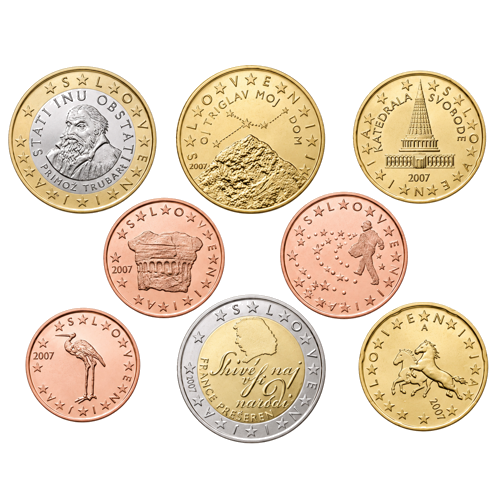
Obverse: The set consists of eight 2007 Slovenian euro coins ranging from 1 cent to 2 euros. The national side of each denomination features a different motif representing Slovenian history, culture and nature. The 1 cent coin depicts a stork, the 2 cent coin the Prince's Stone, the 5 cent coin a sower, the 10 cent coin a motif based on an unrealised design for the Slovenian Parliament building, the 20 cent coin Lipizzaner horses, the 50 cent coin Mount Triglav and the constellation Cancer, the €1 coin a portrait of Primož Trubar, and the €2 coin a portrait of the poet France Prešeren together with a line in his handwriting from Zdravljica, the work that became Slovenia's national anthem. All coins bear the year 2007, the inscription SLOVENIJA and the 12 stars of the European Union.
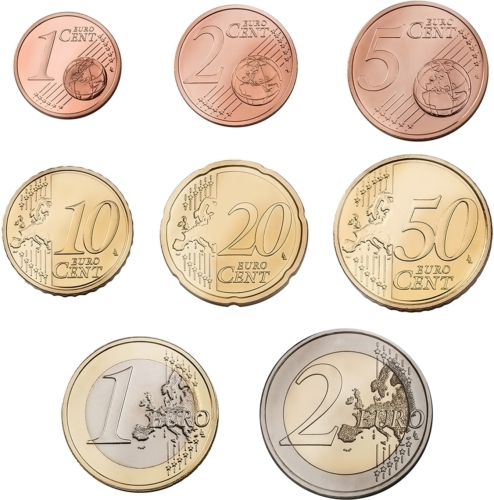
Reverse: The reverse of the coins features the common European design corresponding to each euro denomination. The 1, 2 and 5 cent coins depict Europe in relation to the world, while the 10, 20 and 50 cent and €1 and €2 coins feature the updated common design introduced in 2007, depicting Europe as a single geographical continent. The designs also incorporate the 12 stars symbolising the European Union.
About the coins: The 2007 coins are Slovenia's first national euro coins. Slovenia officially adopted the euro on 1 January 2007 and became the first country among those that joined the European Union in 2004 to introduce the common European currency. The euro replaced the Slovenian tolar, which had been in use since 1991, at the fixed conversion rate of €1 = 239.640 tolars. Unlike many other euro-area countries, Slovenia selected a different national motif for each of the eight denominations. The designs represent the country's historical figures, architecture, nature and national symbols, making the 2007 coin set an important milestone in Slovenian monetary history.