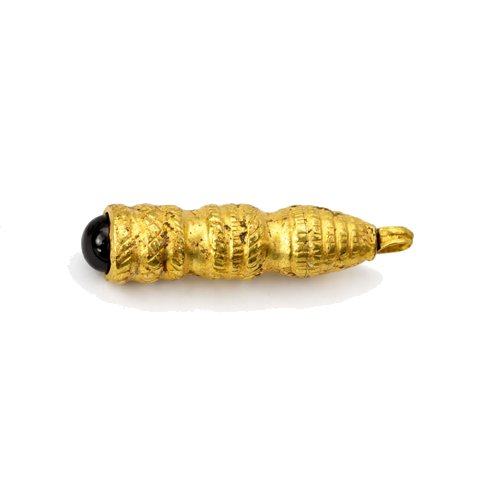
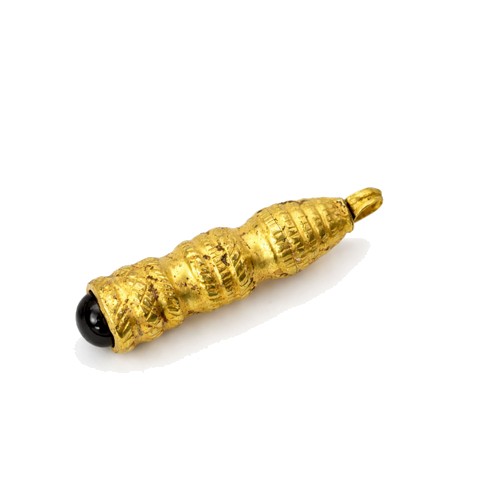
About the item: An authentic Roman Empire era gold pendant-amulet with an almandine cabochon, dating to the 2nd–3rd century AD. This is an elegant piece of Roman jewelry reflecting the high craftsmanship of the goldsmiths and the luxury culture of that time. The pendant stands out for its elongated, segmented mace-shaped composition decorated with subtle relief and engraved ornaments, while its bottom is adorned with a convex dark red almandine garnet cabochon. In the Roman Empire, such ornaments performed not only a decorative but also a symbolic function – they were worn as status symbols, protective amulets, or personal talismans. Due to its excellent preservation, authenticity, and noble material, this specimen possesses exceptional historical, artistic, and collectible value.
Technical Information: The height of the specimen reaches 4.2 cm, weight – 4.88 g. Place of origin – Roman Empire. The artifact is attributed to the late Antiquity period and dates to the 2nd–3rd century AD. High-purity gold and natural almandine garnet were used in the manufacturing. The complex handwork includes techniques of precise beating from sheet metal, relief stamping, surface engraving, and soldering. The condition is assessed as good – the ornament has retained its original construction, with visible natural traces of age, small remnants of authentic sinter (earth/lime deposits) in the recesses, and a minor loss of a fragment due to time, which gives the item additional archaeological charm.
Artistic and Structural Analysis: The pendant is designed in an elongated, symmetrical mace shape, whose hollow volume is divided into several profiled horizontal zones. Each of them is decorated with carefully engraved and impressed geometric, net, and cord motifs, giving the piece plasticity. A sturdy original suspension loop is fitted at the upper part, allowing the ornament to be worn on a chain or a textile cord. The greatest visual accent is the convex almandine garnet cabochon skillfully set at the bottom, whose rich dark red color contrasts with the warm tone of the gold. Such a polychrome composition was highly characteristic of Roman Empire jewelry of this period, where colored stones were valued not только for aesthetics but also for the mystical properties attributed to them. Despite being over 1700 years old, the pendant has retained its clear shape, proportions, and most of its decorative details.
Historical and Cultural Context: The 2nd–3rd century AD was one of the most mature periods of the Roman Empire, when the art of jewelry reached an exceptionally high technical level, and goldsmiths began mass-combining precious metals with colored minerals. Gold pendants-amulets were popular among various social classes, and the almandine embedded in them, belonging to the garnet group, was one of the most favorite gemstones in the Roman world. It was believed that this stone provides protection, strength, and vital energy, which is why it often became a personal talisman protecting against misfortunes. This pendant also perfectly illustrates Rome's extensive trade relations – high-quality garnets were imported to the centers of the empire via the Silk and sea routes from distant regions, including India and Sri Lanka (Ceylon).
Collectible and Investment Significance: The value of this pendant in the international antiquities market is determined by several essential criteria. First and foremost is the unquestionable authenticity: it is an original Roman Empire era gold piece that has retained its primary construction, decoration, and the stone setting itself. Precious gold and natural almandine garnet were among the most valuable materials used in ancient jewelry, and the good preservation state of the specimen allows all decorative elements to be clearly seen. Since such Roman gold pendants appear on the market much less frequently than coins or bronze artifacts, this specimen is highly sought after among ancient jewelry investors, Roman history connoisseurs, and archaeology collectors.