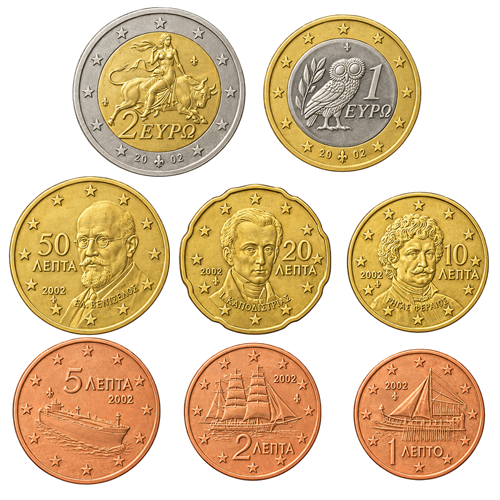
Obverse: The set consists of eight 2002 Greek euro coins ranging from 1 cent to 2 euros. The 1 cent coin depicts an ancient Greek trireme, the 2 cent coin a 19th-century corvette, and the 5 cent coin a modern sea-going tanker. The 10 cent coin depicts Rigas Feraios, the 20 cent coin Ioannis Kapodistrias, the first governor of independent Greece, and the 50 cent coin the prominent Greek statesman Eleftherios Venizelos. The €1 coin reproduces the motif of an ancient Athenian tetradrachm featuring an owl, a symbol of the goddess Athena. The €2 coin depicts Europa being abducted by Zeus in the form of a bull, based on a 3rd-century mosaic from Sparta.
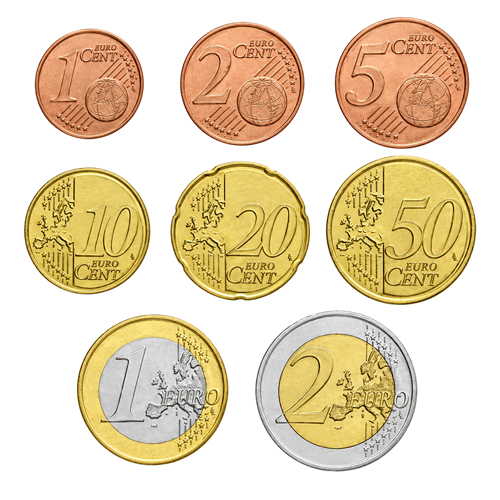
Reverse: The reverse of the coins features the first common European design corresponding to each euro denomination. The 1, 2 and 5 cent coins depict Europe in relation to the world, while the 10, 20 and 50 cent and €1 and €2 coins depict the European Union member states of the time. The common sides of the euro coins were designed by Luc Luycx.
About the coins: The 2002 coins are Greece's first euro coins issued for circulation. Euro banknotes and coins officially entered circulation in Greece on 1 January 2002, replacing the drachma. The national sides of all eight Greek euro coins were designed by Georgios Stamatopoulos, sculptor at the Bank of Greece Mint. The coin motifs are divided into three themes: the smaller denominations represent Greece's maritime history, the 10, 20 and 50 cent coins commemorate important figures in the country's history, while the €1 and €2 coins connect modern Greece with ancient culture and mythology.