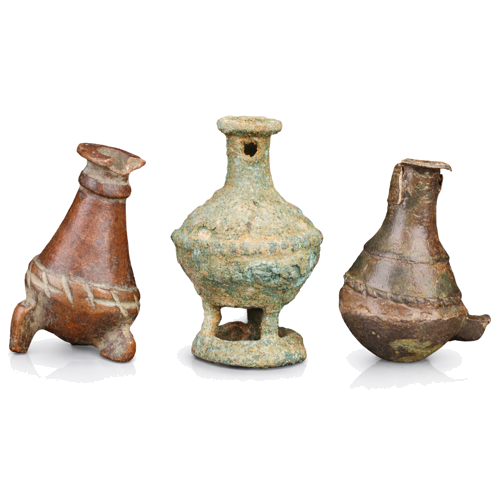
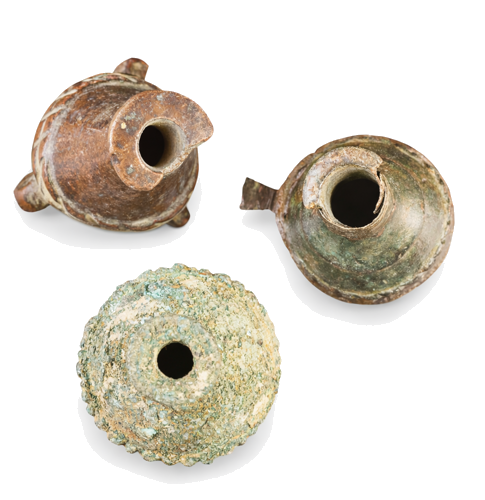
About the item: This fine group of three bronze kohl vessels is an authentic collection of artifacts from the Bactria region, dating to the 2nd–1st millennium BC. Each flask is a specialized cosmetic container designed for holding kohl—a traditional eye pigment. This group represents the typological diversity of forms characteristic of Central Asian Bronze and early Iron Age metalwork, reflecting the high level of personal hygiene and aesthetic culture of the era.
Technical Information:
Object: Group of three bronze kohl vessels (cosmetic flasks)
Culture / Period: Bactria, Central Asia (c. 2nd–1st millennium BC)
Materials: Bronze (copper alloy)
Technique: Hand-casting, hammering, incised decoration
Dimensions: Set objects up to 5.5 × 3.5 × 3.5 cm
Construction: Three flasks of different morphological types: conical with legs, globular with a pierced neck, and ovoid with a collared neck
Condition: Very good; structural integrity preserved, surfaces covered in natural oxidative patina ranging from reddish-brown to deep green tones, with localized mineral deposits
Provenance: Private European collection (acquired in 2020); formerly in old UK and European collections since 1970 (acquired from the UK antique market in 1990)
Artistic and Structural Analysis: The group exhibits significant formal variety: the first vessel features a tall conical body decorated with an incised zig-zag band and set on three splayed legs; the second is distinguished by a globular form and a narrow neck pierced by a small functional hole; the third possesses an ovoid silhouette with a prominent collared neck and flared rim. Each piece demonstrates precise bronze craftsmanship, balancing functional stability with decorative elements typical of the Bactria-Margiana Archaeological Complex.
Historical and Geographical Context: In ancient Bactria, kohl was used not only for beauty but also to protect the eyes from infections and solar radiation. These small flasks were carried as personal luxury items and are frequently discovered in burials from this period as indicators of social status. The varying forms suggest possible differentiation of contents or regional stylistic variations in metalworking.
Collectible and Museum Value: Historical Value: A representative set of Bactrian metalwork illustrating ancient cosmetic traditions. Collectible Appeal: The presence of three distinct morphological types in one set, combined with authentic patina, provides high aesthetic value. Museum Potential: Suitable for thematic exhibitions on Asian archaeology and the history of ancient medicine/cosmetics. Legal Status: Collectible object, legal trade within the EU territory.