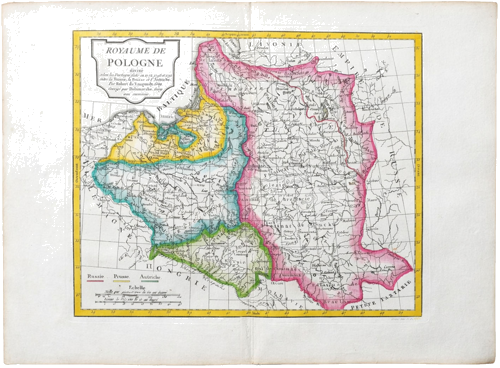
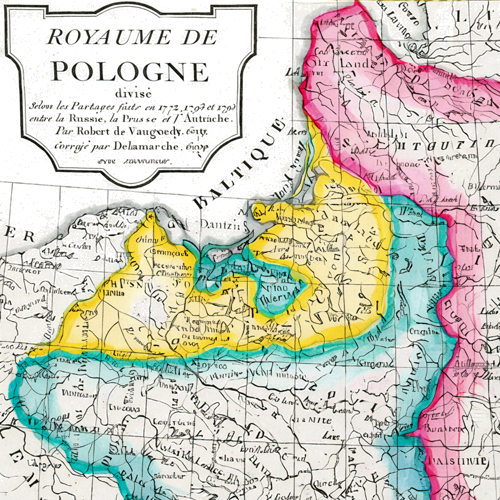
About the item: This is a late 18th-century (circa 1781–1800) historical map titled "Royaume de Pologne," created by the French cartographer Robert de Vaugondy and published in Paris in the famous "Nouvel Atlas Portatif." This atlas was intended for high-level instruction and geographical education. The map is executed using a masterfully crafted copper engraving technique and features original hand-colored territorial borders from the period. The work provides a detailed geographical depiction of the Polish-Lithuanian Commonwealth (the Kingdom of Poland and the Grand Duchy of Lithuania) following the partitions, covering the historical regions of Poland, Lithuania, Prussia, the Baltic regions, and the surroundings of Riga.
Technical Information:
Object: original copper engraving (map)
Title: Royaume de Pologne
Author / Publisher: Robert de Vaugondy (revised and enlarged by C. F. Delamarche)
Place of publication: Paris, France
Period: 1781–1800 (late 18th century – early 19th century)
Technique: copper engraving, hand-colored Dimensions: 45 × 33 cm
Condition: excellent, with minor traces of age
Additional information: wide margins, geographical detail
Scientific and Historical Value: The map reflects an extremely dynamic and complex period of European history. The Vaugondy family of cartographers was renowned for their accuracy and aesthetic representation. This specimen is valuable not only as a geographical document showing the layout of cities (Krakow, Vilnius, Riga), palatinates, and borders at the time but also as an example of high-level printing art. The wide margins and preserved color palette indicate the excellent preservation of the document.
Collectible Value: Original Vaugondy maps, especially those covering the Lithuania and Poland region, are highly sought after among collectors of historical cartography and interior decorators. It is a solid exhibit characterized by artistic elegance and unquestionable historical weight. Due to its authenticity and representative appearance, this map serves as direct evidence of the old structure of European states before the major geopolitical changes of the 19th century.