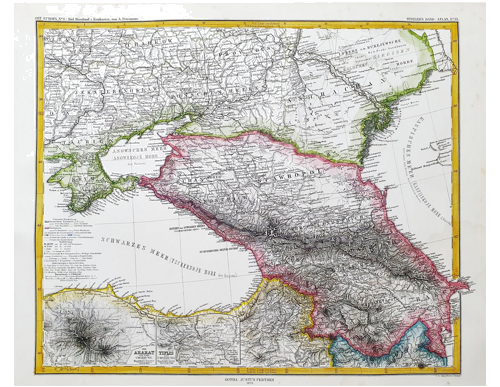
About the item: An authentic, large folio format geographical map from the second half of the 19th century – a representative monument of the golden age of German cartography. The author of this map is the renowned German cartographer Adolf Stieler. Executed using a masterful steelplate engraving technique, this piece was printed in 1873–1874 in Gotha by the famous Justus Perthes publishing house and included in a foundational world atlas. The map features flawless geographical detail, original contemporary hand-coloring, and an excellent, collectible state of preservation.
Technical information:
The overall dimensions of the map are 46 cm x 38 cm. Origin: Germany, Gotha.
Period / Era: late 19th century, specifically the 1861–1880 period, printed in 1873, published in 1874.
Authors and Publishers: Adolf Stieler and Justus Perthes.
Technique: steelplate engraving, hand-colored.
Geographical specification: Eastern Europe, Southern Russia, Crimea, Black Sea, Caucasus, Caspian Sea, and the approaches to the North-Eastern European and Balkan regions.
Condition: good, paper is firm with wide margins.
Structural and analytical breakdown: This map reflects the precision and scientific rigor of the 19th-century German cartographic school. The steelplate engraving technology allowed for an incredibly fine and clear graduation of topographical elements: the relief of mountain ranges, where the Caucasus ridge is depicted with particular expressiveness, a dense river network, road and railway infrastructure, and an abundance of settlement names. The original contemporary hand-coloring with watercolor not only aesthetically frames and separates the political and administrative boundaries of the regions but also grants this folio-format sheet exceptional decorativeness.
Historical and geographical context: This sheet from Stieler's atlas captures the highly dynamic geopolitical situation of the 1870s in Eastern Europe and around the Black and Caspian seas. The map covers territories that were at the intersection of intense imperial interests among the Russian Empire, the Ottoman Empire, and the rising Balkan nations. The Crimean Peninsula is recorded in great detail, featuring names of Sevastopol and other sites of the Crimean War events, while clear borders of the Caucasus provinces and Cossack lands are drawn to the east. The Justus Perthes publishing house in Gotha was considered the global hub for geographical research and the publication of the most precise maps, which is why these works were utilized as official documents in international diplomacy.
Collectible and investment value: The value of this Adolf Stieler map within the antique cartography market is guaranteed by its known institutional source and excellent physical preservation – sheets with full, untrimmed margins are significantly rarer and more valuable. The original, rather than later, coloring and the stable structure of the paper ensure that the piece is entirely ready for professional framing. This historical document possesses long-term investment potential, as late 19th-century geopolitical maps of Eastern Europe and the Caucasus maintain strong popularity internationally. Due to its high informativeness and superb aesthetic qualities, this folio-format engraving will become an elite addition to historical map collections or a luxurious, intellectual accent in an office, private library, or classical interior space.