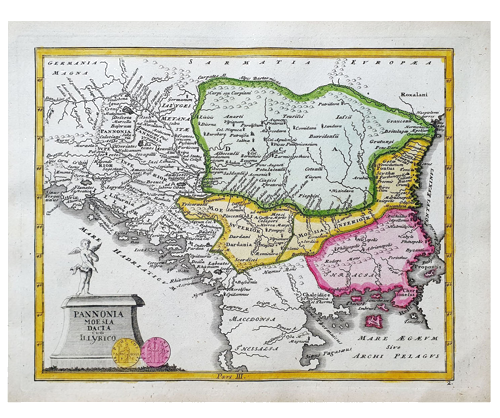
About the item: An authentic early 18th-century historical geographical map "Pannonia, Moesia, Dacia cum Illyrico" – a valuable and highly ornate example of antique cartography, published in Germany (Nuremberg) in 1720. This copper engraving was created by the famous German engraver and publisher Christopher Weigel, with the scholarly publishing foundation provided by the prominent historian and professor of the time, Johann David Köhler. The map features exceptional original contemporary coloring, wide margins, and a rich depiction of ancient toponyms. It is offered in excellent, collectible condition.
Technical information:
Overall dimensions including margins: 23 cm x 18 cm
Origin: Nuremberg, Germany
Era: 1400–1900 (specifically dating to the 1701–1720 period)
Source: Extracted from J. D. Köhler’s foundational work on ancient geography "Descriptio Orbis Antiquii in 44 tables exhibited by IO. DAVIDE KOELERO...", published in 1720.
Technique: Copper engraving, hand-colored
Condition: Assessed as excellent – the paper is sturdy, retaining its original structure and vibrant color boundaries, with wide, uncropped margins.
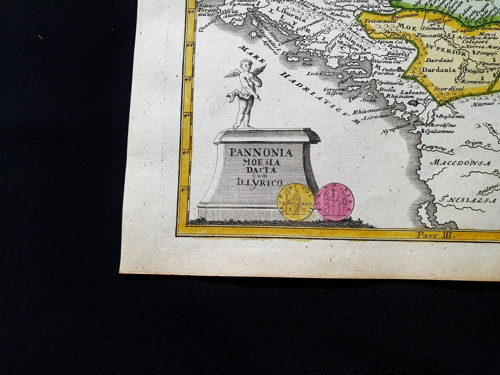
Artistic and structural analysis: This map represents the classic style of Enlightenment academic maps, where great attention is paid to clean lines and clear territorial zoning. The copper engraving technique allowed for precise engraving of mountain ranges (such as the Carpathians or the Balkan Mountains), riverbeds, and a dense mass of ancient tribes and cities. Integrated into the lower left corner is an exceptional architectural cartouche – a classic ancient pedestal with the map title, topped by a winged Cupid figure, and featuring two ancient numismatic medallions or coins at the base. The authentic watercolor coloring (green, yellow, pink) not only visually distinguishes the historical borders of the provinces but also provides the piece with an elegant, decorative liveliness that contrasts beautifully with the thick cream paper base.
Historical and geographical context: This edition is unique because it depicts not the political situation of its time, but the provinces of the Ancient Roman Empire and their bordering territories in present-day Eastern and Southeastern Europe, covering Romania, Bulgaria, the Balkan countries, the Black Sea coasts, and part of Hungary. The map clearly distinguishes historical lands: Dacia, Pannonia, Moesia (Superior and Inferior), Thrace, Illyria, Macedonia, and Sarmatia. With this atlas, Christopher Weigel, together with Altdorf professor J. D. Köhler, aimed to create the most accurate visual guide for students and scholars of the time reading classical ancient texts, so every tribe and city is recorded with maximum historical accuracy.
Collectible and investment value: The value of this Weigel and Köhler map in the antique cartography market is defined by its academic status and excellent physical preservation. Since these smaller-format atlas sheets were often used for intensive study, finding copies with completely intact margins and bright, original coloring is a great rarity. The symbiosis of historical provinces and coin images in the cartouche makes this piece highly desirable among collectors interested in the Roman period and the past of the Dacia and Balkan regions. Due to its high representativeness, stable structure, and enduring historical aesthetics, this three-hundred-year-old masterpiece will become a valuable investment, an excellent exhibition piece for systematic collections, or a luxurious, intellectual interior detail in a private study.
This three-hundred-year-old masterpiece of the Enlightenment era is an authentic document of ancient geography and European history, harmoniously combining the precision of Nuremberg engraving masters, original contemporary coloring, and sustainable long-term value.