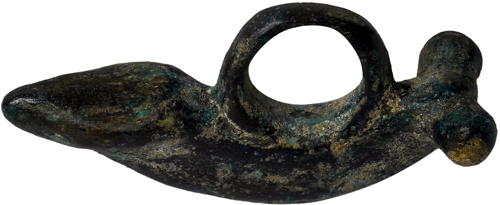
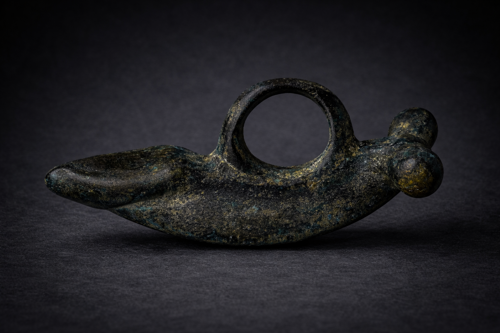
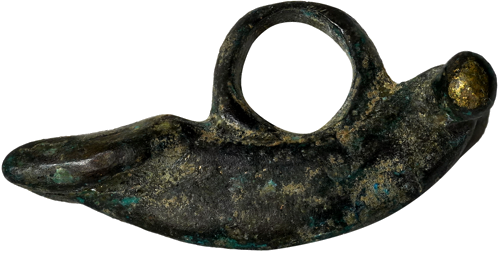
About the item: An authentic Ancient Roman protective amulet (fascinum) from the 3rd century AD – a bronze pendant reflecting one of the most significant apotropaic symbols of Roman culture. This was an everyday object with a clear protective function, used to ward off the evil eye, envy, and misfortune. Valued for its authenticity, symbolic meaning, and age of over 1,700 years, this amulet holds both cultural and collectible appeal.
Technical information:
Culture: Ancient Rome
Period: circa 300 AD
Type: Amulet / pendant
Material: Bronze
Origin (acquisition): United Kingdom
Condition: Excellent, with natural patina
Conservation: Natural, unstabilized
Artistic and structural analysis: The object features a compact, clearly defined form with a functional suspension loop, allowing it to be worn daily. The surface is covered with a natural patina formed over centuries, giving it authenticity and visual depth. The form is stylized yet easily recognizable, consistent with the symbolic expression typical of Roman amulets. This is not a decorative coincidence, but a deliberately created protective form with a clear function.
Historical and cultural context: The fascinum symbol in Ancient Rome was widely used as protection against negative forces. Such amulets were worn by children, adults, and soldiers, and also attached to buildings or vehicles. The 3rd century AD was a period of significant political and religious change in the Roman Empire, yet traditional beliefs and protective symbols remained an important part of daily life. This object reflects a worldview in which magic, religion, and practical life were closely intertwined.
Collectible and investment value: The value of this amulet is defined by several key aspects:
Quality of preservation – clear form and intact suspension loop.
Authenticity – natural patina, without restoration or additions.
Rarity – personal Roman amulets appear infrequently on the market.
Cultural significance – one of the most recognizable protective symbols of Rome.
Age – an artifact over 1,700 years old.
This is a small but meaningful relic of Ancient Rome – a material fragment of imperial culture, combining symbolism, belief, and the human desire for protection against unseen threats.