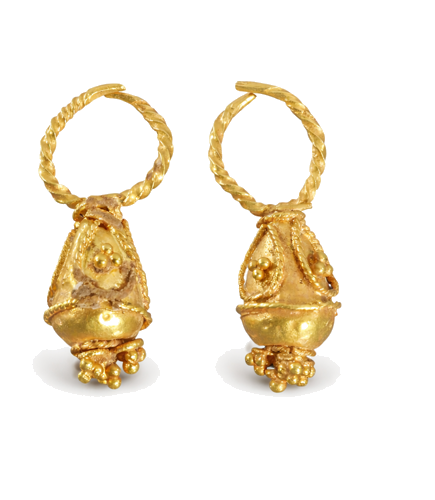
About the item: An authentic pair of ancient gold hoop earrings with teardrop pendants, dating to the first half of the 1st millennium BC. This exceptional jewelry set reflects the high craftsmanship of Eastern Mediterranean goldsmiths in the early Iron Age. The earrings are decorated with twisted gold wire and granulation techniques – some of the most complex ancient jewelry technologies, which required exceptional precision and mastery. Due to its excellent preservation and subtle artistic composition, this pair of earrings possesses great historical, archaeological, and collectible value.
Technical Information: The length of each earring reaches 3.4 cm, and the total weight of the pair is 7.42 g. Place of origin – Eastern Mediterranean region. The artifacts are attributed to the first half of the 1st millennium BC (dated to approximately 10th–6th century BC). The items are made of high-purity gold, applying authentic techniques of precise beating, soldering, twisted gold wire decor (twisting), and fine granulation. The condition is assessed as good: natural archaeological surface features, small remnants of sinter, and fine micro-cracks in the pendants are preserved, typical of gold items of this age.
Artistic and Structural Analysis: The earrings feature an elegant and harmoniously balanced composition. Each ornament consists of a twisted gold hoop – twisted in a rope motif – to which a three-dimensional teardrop-shaped pendant is flexibly attached. This construction provides the ornament with lightness and allows the pendant to move freely. The surface of the pendants is decorated with relief strands of twisted wire forming symmetrical geometric fields. Fine granulation details are arranged within them – carefully soldered microscopic gold spheres that create a subtle play of light and shadow. The composition is completed by small clusters of granules attached to the bottom of the pendants, giving the pieces additional decorativeness and dynamism. Despite being over two and a half thousand years old, the earrings have retained their clear primary shape, construction, and most of the decorative elements, making them an excellent example of early ancient jewelry.
Historical and Cultural Context: In the first half of the 1st millennium BC, the Eastern Mediterranean region was one of the most important cultural and trade centers of the ancient world. Phoenician, Cypriot, Levantine, and early Greek civilizations flourished here, and their interconnectedness stimulated the spread of technologies, art, and jewelry traditions. Granulation and twisted gold wire decoration techniques belonged to the most advanced goldsmithing methods of that time. Attaching the smallest gold spheres to the surface required extremely high mastery and was applied only in high-quality items. Such jewelry usually belonged to wealthy strata of society and was often placed in tombs as valuable grave goods testifying to the owner's social status. These earrings reflect a period when Eastern Mediterranean jewelry exerted a major influence on the art of the entire ancient world and became one of the most important stages in the development of classical goldsmithing.
Collectible and Investment Significance: Early Iron Age gold jewelry preserved in full pairs is relatively rarely encountered in the international ancient art market. Most archaeological finds remain fragmentary or lose one element of the pair, which is why authentic, complete sets are highly valued.