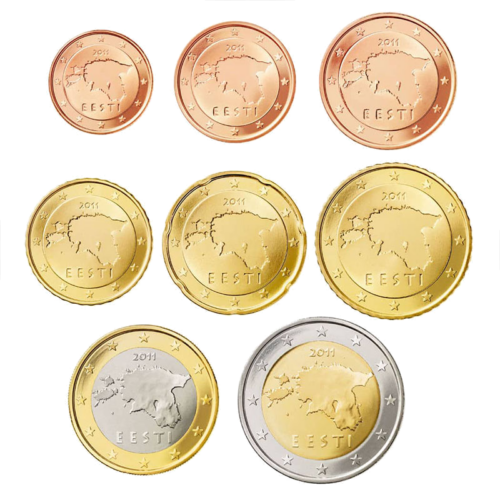
Obverse: The set consists of eight 2011 Estonian euro coins ranging from 1 cent to 2 euros. The national side of every denomination features the same motif – an outline map of Estonia, the inscription EESTI, the year of issue 2011 and the 12 stars of the European Union. On the €1 and €2 coins, the map of Estonia is shown in relief, while on the cent coins its outline is recessed. The map on the €2 coin additionally marks the outermost points of Estonian territory.
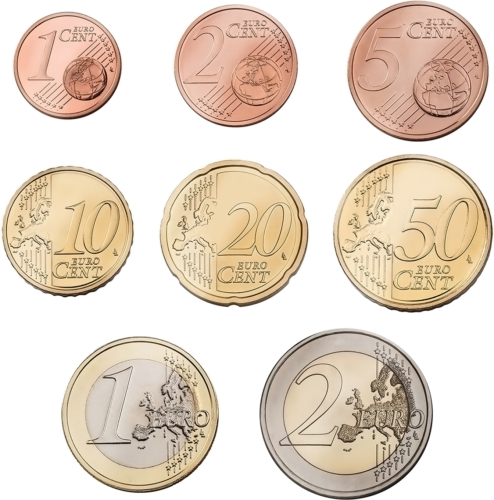
Reverse: The reverse of the coins features the common European design corresponding to each euro denomination. The 1, 2 and 5 cent coins depict Europe in relation to the world, while the 10, 20 and 50 cent and €1 and €2 coins depict Europe as a single geographical continent. The designs also incorporate the 12 stars symbolising the European Union.
About the coins: The 2011 coins are Estonia's first euro coins. Estonia officially adopted the euro on 1 January 2011, becoming the 17th member of the euro area. The euro replaced the Estonian kroon at the fixed conversion rate of €1 = 15.6466 kroons. The national design for all eight denominations was created by Estonian graphic artist Lembit Lõhmus, whose design won a public competition held in 2004. For the introduction of the euro, the Bank of Estonia ordered 194 million coins dated 2011, which were minted by the Mint of Finland. This first Estonian euro coin set marks the country's historic transition from the national kroon to the common European currency.