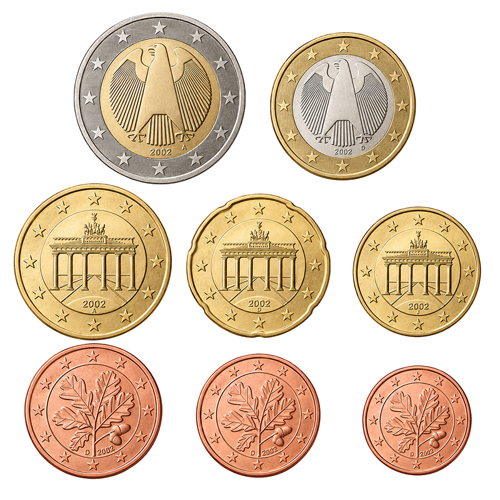
Obverse: The set consists of eight 2002 German euro coins ranging from 1 cent to 2 euros. The 1, 2 and 5 cent coins depict an oak twig, recalling the motif used on earlier German pfennig coins. The 10, 20 and 50 cent coins feature the Brandenburg Gate, symbolising the division and subsequent reunification of Germany. The €1 and €2 coins depict the German federal eagle, a traditional symbol of the country's statehood and sovereignty. All coins bear the year of issue 2002 and the 12 stars of the European Union.
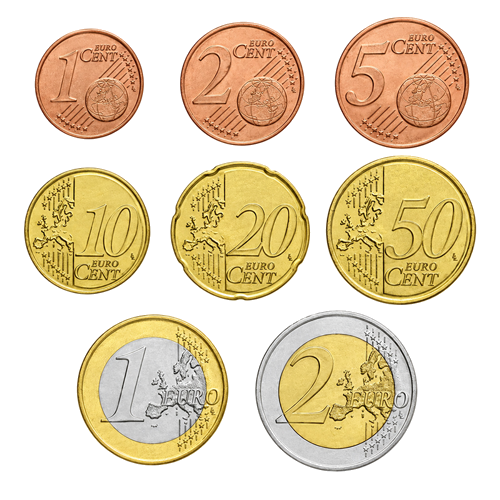
Reverse: The reverse of the coins features the first common European design corresponding to each euro denomination. The 1, 2 and 5 cent coins depict Europe in relation to the world, while the 10, 20 and 50 cent and €1 and €2 coins depict the European Union member states of the time. The common sides of the euro coins were designed by Luc Luycx of the Royal Mint of Belgium.
About the coins: The 2002 coins are Germany's first euro coins issued for circulation. Euro banknotes and coins were officially introduced in Germany on 1 January 2002, replacing the Deutsche Mark. Three easily recognisable national symbols were selected for the German coin designs. The oak twig was designed by Rolf Lederbogen, the Brandenburg Gate by Reinhart Heinsdorff, and the federal eagle by Heinz Hoyer and Sneschana Russewa-Hoyer. This 2002 set marks Germany's historic transition from the Deutsche Mark to the common European currency.